







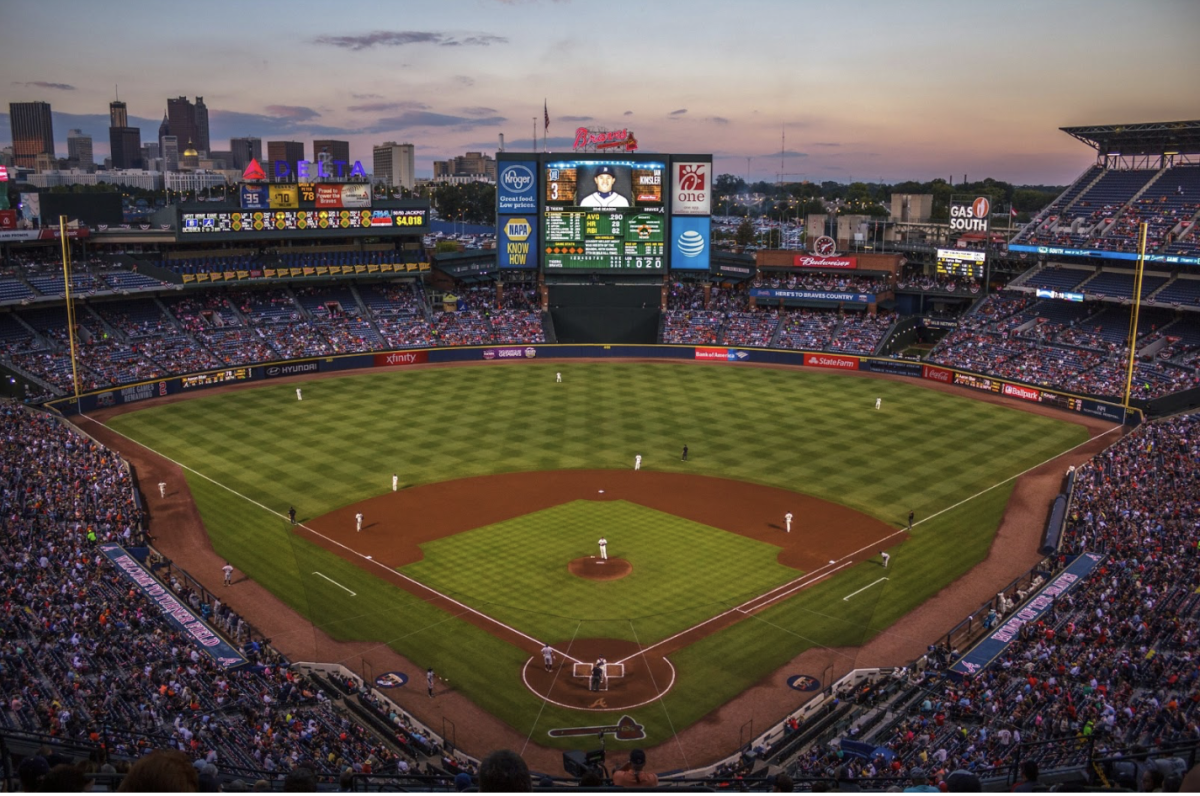


































I love baseball. The atmosphere, the food and most importantly: the unpredictability of the game — how anyone could cause the game to flip with just one pitch. But when the same team is victorious for more than two years in a row, the game becomes a bit more predictable and dreary to watch.
When that same team also has a budget way larger than any other team and can acquire all the best players in the league, what’s the point of watching when I can predict the outcome? The team in question is the LA Dodgers. With a budget of $508.3 million, according to spotrac, it’s almost unfair to teams like the Colorado Rockies who were bad before but hardly have a chance now with a budget of $105.3 million. Even big teams like the Chicago Cubs and New York Yankees can’t compete with their larger budgets of $240.9 million and $399.1 million, respectively.
The only team close to the Dodgers are the New York Mets with a budget of $481.3 million. While a $30 million difference doesn’t seem like a lot when talking about hundreds of millions of dollars, it can be a big difference for any team. According to Statista, “The average salary for a player in the MLB stood at $5.2 million in 2025.” With $30 million teams could hypothetically obtain six players or one really good player.
With most MLB teams working with a budget under $200 million, which is less than half of the Dodgers’ budget, how are these teams even able to compete? The answer is simple: they’re not. If one team can acquire all the best players in the league, they essentially have a monopoly on the sport. Yet monopolies are supposed to be illegal in the United States; there’s always supposed to be competition in the marketplace. If this is a principle of our country and economy, then why does it not apply to our sports as well? A place that is supposed to be competitive should allow for an equal playing field. In a competitive marketplace, there’s the chance for multiple brands or companies to profit. The same should be true for baseball, allowing more than a select number of teams a chance at winning the World Series. Teams may get lucky sometimes and beat the Dodgers, but I don’t think that with their current roster and budget, the Dodgers could get so extremely unlucky that they don’t make the playoffs. Ohtani is a beast by himself and a once in a generation player, but so is most of the Dodgers roster. Even ESPN is predicting another Dodgers victory this season with +375 odds on ESPN BET.
What I think the MLB needs to do is enact a spending cap. Teams already have something similar, a luxury tax, which you have to pay if you exceed a certain amount of spending. But it’s clear this tax angle isn’t working, as teams like the Dodgers can afford to pay $100 million.
We need to have stricter rules on how much teams can spend. Now, I don’t think everyone should be reduced to the Rockies’ spending limit, as teams should be able to spend any money they rightfully earned. What instead needs to happen is a cap on the amount that can be spent obtaining players. A possibility could be that once a team reaches a certain limit, any additional money can only go to maintaining the stadium and paying stadium employees and coaches — as long as it’s not buying players.
I know some people are against spending limits and think better players deserve to be paid more, and I’m not saying they shouldn’t be paid more, but I don’t think any one individual playing a sport should receive $700 million (which is how much money the Dodgers signed Shohei Ohtani for a 10 year contract.)
I just want baseball to be the sport I love again, where I can root for my team and believe they still have a chance – even when that team is the Chicago Cubs. Spending caps might be the only way to save baseball from becoming a monopoly run by the Dodgers. Therefore, I hope the MLB is looking into how to fix this problem by the 2027-28 season. For now, we’ll have to wait and see what happens this season. Maybe the Dodgers will lose and the salary cap talk won’t be as relevant anymore. Who knows? Like I said, baseball is an unpredictable sport.